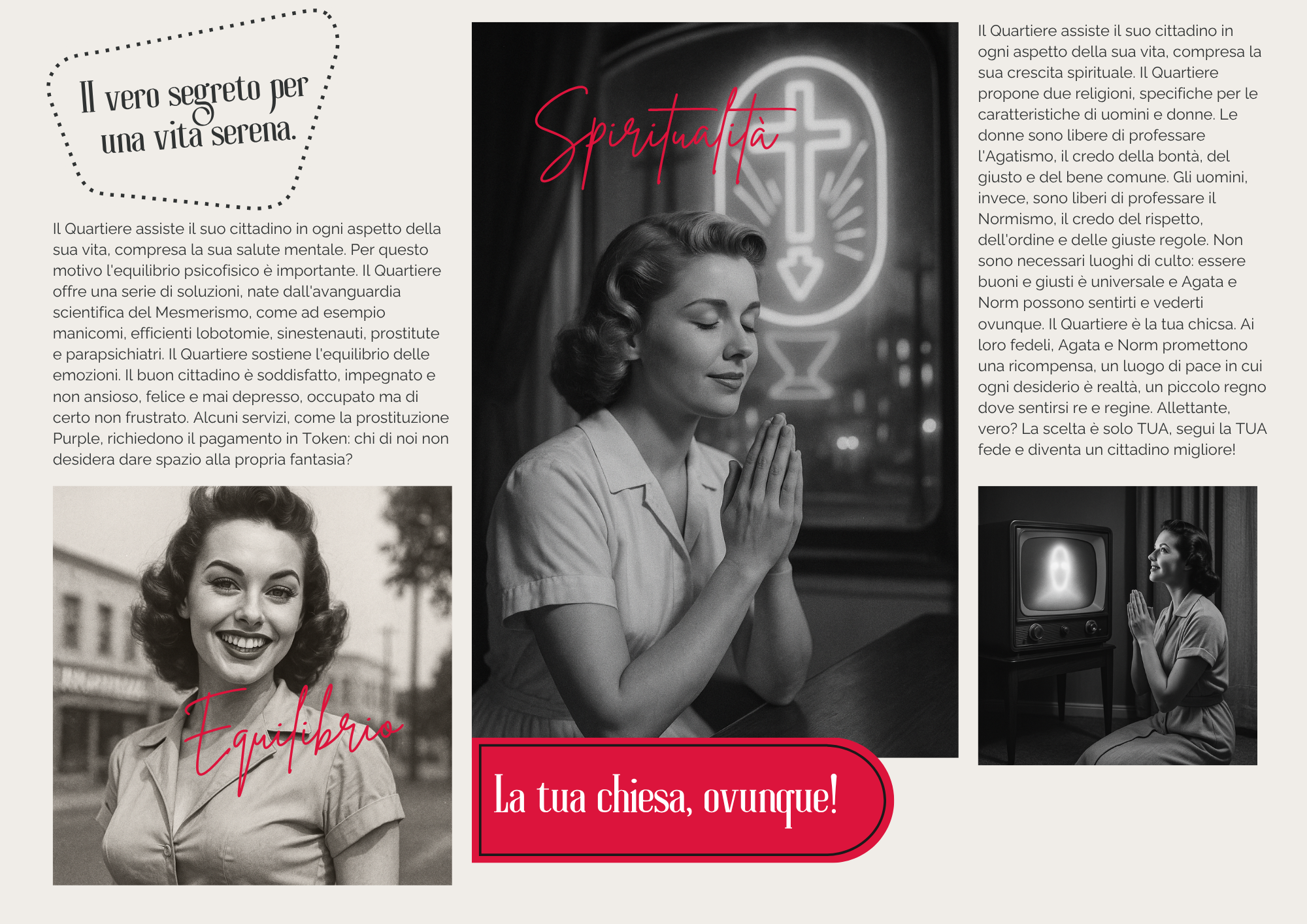
The Neighbourhood assists every citizen in every aspect of life, including mental health. For this reason, psychophysical balance matters. The Neighbourhood offers a range of solutions born from the scientific vanguard of Mesmerism: asylums, efficient lobotomies, Synaesthenauts, prostitutes, and parapsychiatrists. The Neighbourhood supports emotional balance. A good citizen is satisfied, engaged but never anxious, happy and never depressed, busy but certainly not frustrated. Some services, such as Purple prostitution, require payment in Tokens: who among us does not wish to give their fantasies room?
Glitter
The Neighbourhood · a part of you
Balance
The Neighbourhood’s prostitutes do not sell their bodies. They sell their souls, accompanied by a pinch of dignity and a massive dose of self-hatred.
Another important requirement for being a Purple is not knowing the meaning of the word respect.
My name is Petit Mal, and I know that respect is another word for silence.
I spend my evenings naked before the mirror, pausing to admire my bruises. They enchant me, colouring my skin and giving it a natural swelling that plumps my cheeks.
My original, translucent complexion is only a memory now. I always hated all that white, as though it were a book without words, without a story.
The bruising, instead, has a story—a reason to exist, to spread across broken epidermis. Sometimes it may make no sense, but it always has meaning.
I have a dream tucked away, like every good girl in the Neighbourhood: to become an actress. I tried, but I prefer acting all the time rather than on request.
I do not know how to be myself—or rather, I do not want to. I have ordinary looks, ordinary feelings, ordinary fears, and above all ordinary desires.
The Neighbourhood is my chance to be exceptional. When they offered me work as a Purple, I thought nothing could be more abnormal. “Perfect,” I answered that day. I have regretted nothing since. I have few clients, all of them loyal.
We exchanged our first awkward blows when I was seventeen. I am twenty-seven now, and around Christmas I find myself thinking of them.
Alvis is seventy-six, a father and a lazy man. He comes every Monday and Friday from five to six with his son, to share a moment of bonding flavoured with Camel tobacco. I sit between them as the ashtray. They take turns smoking the little white cylinder, the fine brown line around its filter drawing a horizon above the stylised head of the blue dromedary.
They draw deeply, then balance the cigarette against the side of my mouth, the tip of my tongue pressing the centre of the damp white paper. Ash slips down my throat. The grey powder mixes with saliva and becomes a long, lumpy filament running along my gums before the swallowing reflex sucks it away. Bitterness takes possession of my body. My eyes struggle to remain open and my Adam’s apple sways gently, trying not to make a sound as it escorts the lump on its final journey to the oesophagus. Tonight it will burn. It will send me running to the bathroom to vomit, colouring the porcelain with grey and red ink.
I like colours. As a child, there was no better pastime than colouring. The Neighbourhood let me draw pink grass, a blue sky, and my body purple.
When father and son finish their chat, they stub out the cigarette ends on my tongue and leave them in the darkness of my mouth, which I close slowly. I swallow. The Tokens fall onto the lavender carpet, and then the door closes politely.
Alvis pays three Tokens, the standard service, as does my second client.
Ois is forty-two, lonely and married. He comes alone on Thursdays at one o’clock, during his lunch break. He works at the C.R. office—Contract Registration—and sometimes, instead of Tokens, he gives me his lunch as payment. He says it is rather like a date, and meatloaf is his favourite.
He is a model citizen. He has never missed an appointment, and he beats me courteously.
He lets me catch my breath between punches and has never slapped me: humiliation’s blow.
He beats me while breath remains in his body. Then his arms grow heavy, the blows slow, and his accuracy falls. At that point he stops. I feel a kiss on the top of my foot, intact and unswollen. Then he leaves, his jacket pinched between two fingers and slung over his shoulder, his neck wet. I can always see it between his damp hair.
My last client, instead, is a woman. She likes acting. Unlike me, she has no real passion for it, but she is good. She writes the scripts for our appointments: the same characters, few variations. A married couple. She plays the husband, I the wife. She loves and hates him. He beats her, but not like the other clients: he beats her because he feels nothing.
She comes on Mondays at four, dressed like a respectable man of the Neighbourhood, faithful to Norm, in the classic pleated beige suit and white shirt. Every garment hangs loose, at least three sizes too large. I open the door in a red-and-white striped coat dress like the one recommended by the 1953 Alden’s catalogue. It has large, deep pockets. I bury my right hand in one while opening the door with my left.
She enters without greeting me, dropping the usual script on the floor. I pick it up, and from that moment the sheaf of paper becomes an ever-present accessory, like Spray Net Hair lacquer: “Smart girls never go out without it.”
We sit in the living room, occupying the only two chaises longues. The glossy black table between us, with its anorexic legs, barely holds our reflections. We exchange the day’s lines. He—or she—asks whether emotions can overlap like two people arguing, whether at some point one can go out as though a slap had silenced the other. I listen and answer according to the script. “I do not understand you,” I say, and he begins to beat me. We start gently, only a few punches. Another exchange follows: the husband asks whether it is possible to know that he loves her without feeling it. The wife answers in confusion, scratching her backcombed hair and asking for an explanation. The husband has none, so he beats her again.
And so it continues, a back-and-forth between two people speaking the same language with different meanings. During our little play, Giò has only one request concerning the physical part of our session: glitter.
Before she arrives, I insert tiny balloons filled with glitter along the contours of my face, beside the veins of my arms and legs, and beneath the pads of fat on my stomach, breasts, and cheeks. Each blow bursts them, scattering tiny bright, sticky dots. They sparkle more brightly with blood.
They are fireworks—warm, colourful—ignited by a violence made of pure misunderstanding.
Giò is not cruel. She does not sweat, and she does not hurt me. She makes me more beautiful. Beyond the colours, she fills my skin with cheap diamonds. I feel like a mermaid out of water, and sometimes, with her, I cannot breathe.
When she hits me, she asks whether I can feel it. The first few times I described what I felt, as Ois likes, but that was not what Giò wanted. She only wanted to know whether the pain was real, whether I perceived it—not what I perceived.
And I never lied to her.
I felt it, and wondered who the stranger was who could not: what sterile, apathetic man could fail to sense all that mutilated passion?
At the end of every session, Giò listened to me for a few minutes, as though it were her emotional tip, and I liked that. I told her everything, but in short, digestible pills, as though my thoughts and desires were as elementary as a child’s drawings. I would have liked to argue, explain myself, go deeper, but Giò was tired of that. She hated dissecting thoughts more than she hated dissecting her patients.
After the tip, she left, slamming the door.
Oggi però non se n'è andata: è ferma in cucina, con una tazza di fumo fra le mani.
Ha portato con sé una valigia, un piccolo cappello da giullare è inciso sulla pelle marrone e dura.
«È per te»mi ha detto. «Te li regalo. Puoi usarli per recitare.»
È seria. Crede davvero possa recitare: gliel’ho confidato una volta, in una delle mie pillole.
Voglio essere un'attrice, le ho detto. Non le ho detto che voglio essere chiunque, tranne me stessa.
She took me seriously, which is why she left me all her clothes. A substantial tip and few words. I want to thank her, but she will not look at me. She put out her cigarette and, for the first time, closed the door gently. Too gently. She left a gap, and I watched her through it. She is not going home. She walks straight ahead without following the road, cutting through yards and fences towards the brick wall surrounding the Neighbourhood.
In the background, the sound of rain preparing to fall and the distant chime of bells.
Months have passed since I last saw her. Giò never returned, and I too tried to do something liberating. I stopped selling myself and went to a few auditions, for R.I.P. or The Neighbourhood Distillate.
I lasted a month. I was uncomfortable. There was too much sense, too much respect, too much love for myself in that life. I know it, and the Neighbourhood knew it better when it offered me the role of Purple: when you are no one, you might as well leave someone else the responsibility of a name. They had given me one. Petit Mal. I was the lesser evil.
I understand that I must excel at my art: prostitution. And Giò will be my inspiration. Like every actress, I improve the role, make it unique and inimitable. That is why I do not hide, Giò. That is why I do not run away.
Because I am a better version of you.