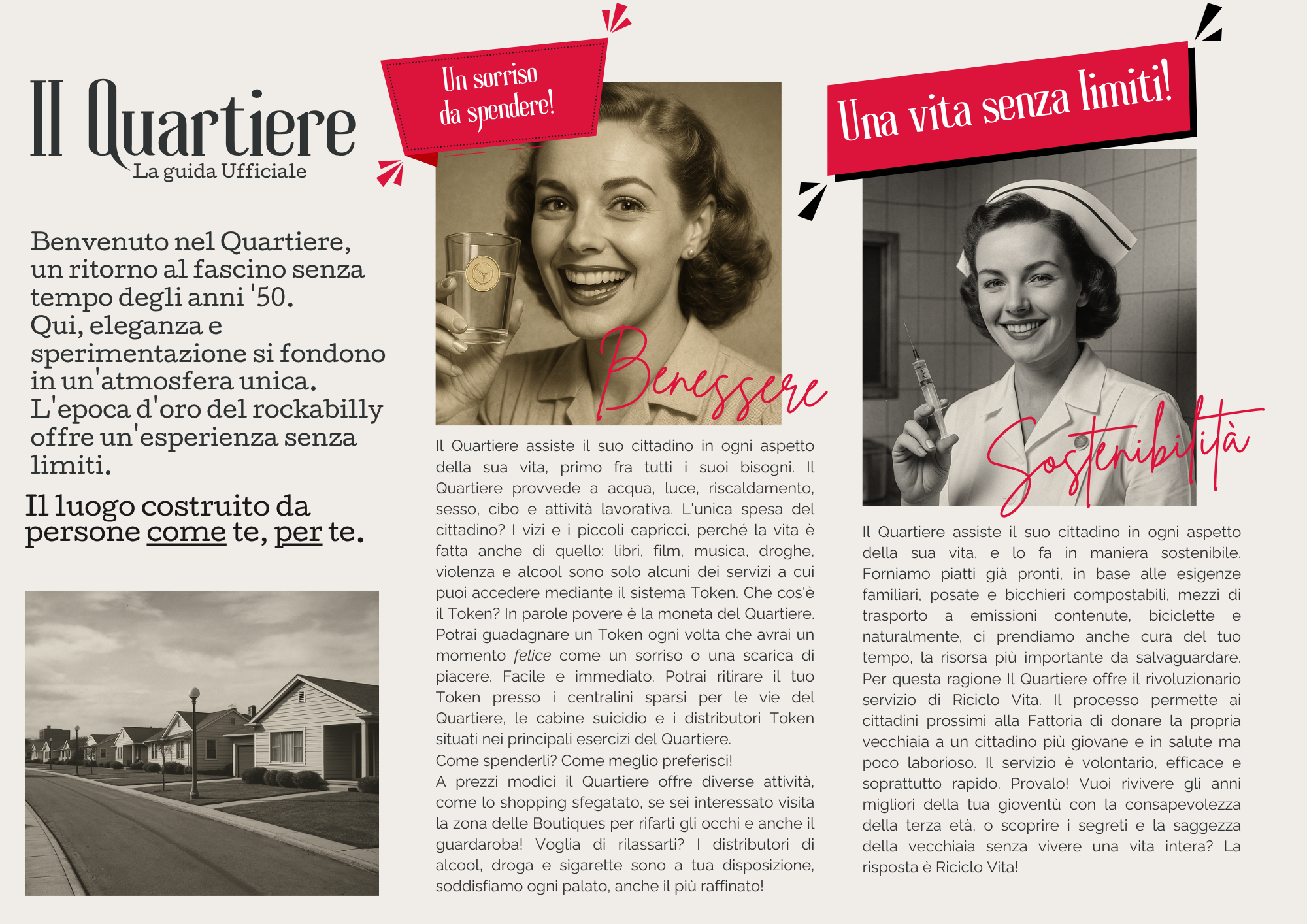
The Neighbourhood supports its citizens in every aspect of life, sustainably. We provide prepared meals tailored to family needs, compostable cutlery and cups, low-emission transport, bicycles and, of course, care for your time—the most important resource to protect. That is why the Neighbourhood offers the revolutionary Life Recycling service. It allows citizens approaching the Farm to donate their old age to a younger, healthy but less industrious citizen. The service is voluntary, effective and, above all, quick. Try it! Would you like to relive the best years of your youth with the awareness of old age, or discover the secrets and wisdom of ageing without living an entire life? Life Recycling is the answer!
Life Recycling
The Neighbourhood · a part of you
Sustainability
Lola
The summons has arrived.
I walked with my cane striking first against the wooden porch, then down the uneven stone path to the shiny red letterbox. I opened its metal mouth. Inside there was only one envelope, pink, with red letters spelling URGENT.
On the back, the Neighbourhood’s signature: a slice of cake moving away from its original, circular shape.
I opened the envelope. The letter was white, its black letters blurred, and the smell of stale cigarettes soaked the air:
Citizen no. 08051963
The time has come.
The Farm awaits you.
The Neighbourhood will arrange your move on 28 May.
Signed
The Neighbourhood, a part of you.
I tightened my grip on the cane. At its top, the duck’s head, tarnished gold, trembled as if the little decapitated creature were struggling through one endless no.
Pier
The summons has arrived.
I shuffled down the path to the shiny red letterbox. I opened its metal mouth. Inside there was only one envelope, pink, with red letters spelling PRIORITY.
On the back, the Neighbourhood’s signature: a triangle reminiscent of my grandmother’s old iron, fleeing its broken circular enclosure.
I opened the envelope. The letter was white, its black letters blurred, and the smell of a pharmacy fouled the air:
Citizen no. 04051990
Your request has been accepted.
The Life Recycling Service thanks you.
Your appointment is scheduled for 27 May.
Signed
The Neighbourhood, a part of you.
Lola
It is the twenty-seventh of May. I thought about it too long. If I had come earlier, I would have found something better. At least I make a good impression now; it looks as if I gave it thought. I see the nurses behind the desk, gossiping with their firm arses and pointed tits.
I had those too, about sixty years ago, and I certainly never played so hard to get. I knew how to give a little, if only through a look, some innocent advance. Today’s little women all think they are queens, and they should thank the Neighbourhood for giving them a castle without a husband.
They snigger. Gossips. They do not even try to lower their voices, hide their faces, or avoid my eyes. I know they are talking about me: the old woman who still dares to live, who has the nerve to steal the youth of poor, sad, innocent girls.
“Are any of you among the candidates?” I ask, my tongue spitting saliva and venom.
The brunette of the trio turns around.
“No. The candidates are in the waiting room behind you.”
“Just as well,” I retort. “You’re hideous. I might as well go straight home instead of wasting my time.”
All three lower their eyes and, as if summoned by a phantom whistle, scatter towards the four corners of the clinic.
Silence at last. I would like to read one of the magazines thrown onto the white table, but I am agitated and the lighting does not help. The clinic has dreadful fluorescent lights, walls that are too thin, and chairs designed by some bastard with a lovely fat round arse, because I can feel my bones scraping against the slippery plastic. It hurts, and makes an irritating, grotesque noise besides.
Pier
The waiting room is white and sweet, as if every element, plants included, had been dipped in a mixture of milk and bleach. The lights are soft. The clear panes let in the darkness of the Neighbourhood and create an intimate atmosphere, ideal for reading. I take out my red book, its title stamped in gold: Pride and Prejudice by Miss Austen. I cast one final look around: seven girls along the right wall, seven boys along the left. Young. Alone. Around their necks hang the badges for Life Recycling candidates, coloured by a smudged number. Some look at one another; some exchange knowing smiles; others stare into space or, like me, seek refuge in a book or magazine.
In the background, the Neighbourhood’s theme presses on: fake crickets, buzzing, noises like photocopiers, all punctuated by the nurses’ white heels and the murmurs of these near-strangers.
“He’s cute, isn’t he?” The red-haired girl beside me places one hand on my shoulder while one shy finger points towards the row of male candidates opposite.
I narrow my eyes, confused.
“That one, in the pink shirt. He’s cute, isn’t he?”
I follow the shy finger. To me they are all the same: simply male, men, boys. Not to them. To them a man is something more, the only thing capable of violating their solitude. I do not understand them. I love my solitude. I prefer my silence to other people’s awkward silence.
“I think he’s made up his mind about recycling,” another girl interjects from the next-to-last chair, horses running over her Hermès scarf.
“What a shame!” says the redhead. “Know anyone who’s unsure?” she insists.
“The boy opposite the blonde, in the red striped shirt. But he’s a bit ugly,” says the scarf, her lower lip heavy. “That’s why he’s here: a woman or death!” The redhead laughs, and so do the others. Everyone except me and Muriel. She never laughs.
She touches up her make-up, sits, and says nothing. She keeps her neck stretched to smooth the wrinkles, hide the shadows, brighten her complexion as much as possible. The nurses say she is an institution. I heard them talking in the bathroom, like schoolgirls: Muriel has applied every month, but she is now old by recycling standards and no one wants her.
Today is her last chance. After this, only the Suicide Booth remains.
“Muriel. Pleased to meet you.”
The voice clashes with that powerful body. A bird’s voice emerging from an elephant.
I turn towards the square face and introduce myself. “Pier. Pleased to meet you.”
“Is this your first time, Pier?”
“Yes,” I lie, but not too much, like a proper young lady. It is my first time at Life Recycling, but not the first time I have tried to free myself from my life.
“You?”
I am making conversation. Something I hate: listening to other people, and listening to myself even more. But today I have nothing to lose. I can say the wrong thing, smile badly, speak too quietly, fail to look interested enough. Today it does not matter.
“No. I’ve come several times. At first I was looking for someone to talk to, someone who felt the way I did. Not necessarily a man, even just a friend, but friendships are difficult,” she chuckles.
She reminds me of myself when I was younger. I wanted something like that too.
“Difficult?” I want to understand what difficult means to her.
“Yes. Difficult because people love going out, having fun, being entertained, and keeping up is hard when you have no Tokens.” She pauses. “When you can’t manage to be happy.”
We are alike. A burning in my eyes makes me wish I had met her earlier, but the wish goes out at once: eventually we would have found ourselves together inside a Suicide Booth, holding hands.
“I’m not very good with people.” I play the good girl. Kind and thoughtful, like a proper follower of Agatha, even though I have never had faith.
“It shows.”
Muriel’s answer is cold. A particular kind of cold, like gravestones in summer. I leave her alone, return my attention to Jane Austen’s words, and understand that we are all here for the same reason: to stop being a burden. A burden to ourselves, to our families, to the Neighbourhood.
The laughter in the background falls silent, as if rebuked by a teacher’s voice, though a few giggles remain when one of the boys approaches. He exchanges a couple of words with the redhead, tears the badge from his chest, and they leave arm in arm. The redhead’s skirt puffs around the corner and disappears. It was painfully quick.
Lola
A couple pass in front of me: a red goose and a finch of a boy. She smiles at me and I smile back. I would not have chosen you anyway. I watch them leave through the clinic’s revolving door. They laugh, their laughter mixing with the sound of tiny bells.
“Lola?” A hand strokes the shoulder of my jacket.
I turn.
“Doctor Giò. Is it time? Should I stand?”
“Slowly, Lola. There are still about ten minutes, but I wanted to take you to my office in the meantime.”
Giò smiles, raising her neat eyebrows. Her eyes open; her lips barely tremble with the movement. She offers me an arm. I cling to the white sleeve and pull myself up. I smooth my skirt: a midnight-blue 1959 Sears dress with matching jacket, because “Sears puts the accent on style”. Perhaps I overdid it, but this feels like a special occasion.
“Still decided? You would prefer a female body, correct?” Giò asks without looking at me.
“Of course! I adore my old dresses. I can’t wait to wear them again!”
I strike the cane and laugh. The duck trembles. Giò does not join in. Her gaze is fixed. No one is an accomplice today.
Pier
A shadow darkens the pages of my book.
“Excuse me. It’s time. You need to follow the other candidates.”
The nurse gestures with an open hand towards the only two girls left: Scarf and Muriel. Opposite me there is only one boy.
The others have either fled or found company. I thought the rumour that the Life Recycling waiting room was a sort of matchmaker was only that: a rumour.
“I’m sorry. When I read, I lose track…” The sentence hangs unfinished: the nurse looks bored. I stand, hold the book against my navel, and follow the line. Head down. In the distance, a bell. I turn: the solitary boy is leaving.
Coward.
Lola
Giò’s office reflects her appearance, not her personality. She is blonde, tall, a Viking. The furnishings are minimal, pieces of furniture far apart and chasing one another, pale colours, and the interrogating fluorescent light, like a prison lamp.
On the veins of the desk sit three files, three photographs, three names.
I stiffen.
“I don’t want to read anything, Giò. I want to see them and choose. End of story.”
The doctor settles behind the desk, stretches out her arms, gathers the bundles of paper, and slams them into a drawer.
“As you wish.” With a blue fingernail, she presses the intercom’s red button. “Send in the candidates.” The machine croaks and goes dead. Giò smiles and concludes, “You’re lucky. There are three left today.”
Pier
The office into which the nurse has led us is elegant but uneasy, as if it ought to belong to someone else.
“Line up here,” the nurse orders, arranging us side by side like crooked birthday candles. “The procedure will be supervised by Doctor—”
“Call me Giò,” interrupts the blonde woman behind the desk, her white coat an identifying mark, her eyes grey and small. The nurse falls silent and sits beside the doctor, a plastic folder balanced on her knees.
Giò invites “Lola” to turn around. I am in the middle. Lola’s shoulders are narrow and crooked, as if the jacket weighs too much for that tiny woman. When she turns, I am struck by two bullet holes, deep and round: wrinkles rippling across thin skin, a mouth that seems to peel like a vanilla pod. She smells like one too: vanilla and counterfeit good breeding.
Lola
“Turn around, Lola, and choose.”
Giò’s invitation is uncertain. I turn slowly, strangle the duck on my cane, and tilt my head. The first person before me is a dark-haired girl, green eyes and a mole like a black tear: a Pierrot of flesh and blood.
She is one in colour too: faded white Betty Barclay dress, cream-wallpaper skin, cracked hands clutching a copy of Pride and Prejudice. The apotheosis of the sad, lonely woman cliché. Her mouth is a line, and I imagine lipstick smudged for lack of muscle and mucous membrane. She is wedged between two women: a blue-eyed spinster and a blonde wrapped in a Hermès scarf. My eyes slide from the scarf to the ankles and strip her: I want her. The instant I form the thought, the girl bursts into tears and begins gurgling disjointed apologies—“I’m sorry”, “I’m terribly sorry”, “I can’t”, “I waited”, “I have to go”—and runs away. The bitch with the fake Hermès and my new life has fled. She slipped away on the cowardly tips of her shoes, hands at her hips like chicken wings.
Pier
Only Muriel and I remain. The doctor rummages through the pockets of her coat, takes out a cigarette, and lights it. She draws quickly, as if the smoke were feeding her synapses and supplying the words.
“I’m sorry for the inconvenience, Lola. There usually isn’t much choice among the candidates.”
“I paid for the service and for the choice,” the old woman hisses.
“And the Neighbourhood allows you to choose between Miss Pier and Miss Muriel.”
The cigarette smoke marks the pause between the two names. Lola’s jaw creaks and violently snaps the doctor’s irony and lightness in two.
“I’ll take the one in white.”
She chose me. It was painfully quick.
Lola
I want to cry. I suck the tears into my mouth, mix them between my teeth, chew hard, then swallow everything in a scowl.
I had no choice. I paid, and I had no choice.
The gossiping nurse escorts the spinster out. The blue-eyed wardrobe wears my expression, as if she has swallowed the whole of Pandora’s box, hope included.
Pier
I sit beside Lola.
Doctor Giò hands the document to both of us, her hands wrapped in a faint white cloud of smoke. Time to sign.
“Read the contract carefully and sign it. Then we can move to the adjoining room and begin the recycling. If you have questions, now is the time. You may speak to each other if you are curious about anything, or ask me if you have doubts.”
The contract paper is thin, clipped to a polished wooden board. I skim the bureaucracy and focus on the characters setting out my citizen number and my future:
Citizen no. 04051990, you surrender your body to Citizen no. 08051963.
You will live the rest of your life in Lola’s body, Citizen no. 08051963, retired at the Farm, until natural death occurs.
Citizen no. 04051990 undertakes to live in service of the Neighbourhood and its citizens, without the possibility of suicide.
At the bottom, in one corner, barely visible, someone has scribbled a jester’s cap. I have seen others at the Neighbourhood Library.
Lola
I cannot hear the doctor, and I do not want to. I see only her lips moving soundlessly and curling around smoke.
I tear the contract from her hand and place my pen against the page:
Citizen no. 08051963, you surrender your body to Citizen no. 04051990.
You will live the rest of your life in Pier’s body, Citizen no. 04051990, until natural death occurs.
Citizen no. 08051963 undertakes to live a full life in the Neighbourhood, without the possibility of suicide.
My pen hangs suspended, but I can hear a ballpoint rolling over the cellulose. Pierrot has signed.
Pier
It was painless, as if the pen had moved by itself. An energy I had not felt in years shocked my muscles, moved every nerve, and stained the page with the name the Neighbourhood gave me.
Then I smiled, first at Lola and then at the doctor. I had not smiled in years, and something creaked, inside and out. A trill makes my pager vibrate. A cinematic scream escapes me, the kind actresses release before fainting: I have received a Token. I cannot remember the last time I earned one. I detach the pager from my belt and place it on the desk, sliding it towards Lola. Take it, I say to myself. I am no longer a parasite.
Lola
Pierrot and I walk side by side. My grey curls brush her shoulder. She is tall. She would be taller still if she held her back straight.
Giò leads us into the adjoining room and, obediently, we sit in the armchairs at its centre. Back to back. No contact during the procedure.
I need to pee. Damned excitement.
Pier
The chair is clammy. The fake-cotton dress sticks to my back and thighs. We sit back to back. No contact during the procedure.
The fluorescent light’s hum is almost musical. I feel thoughts settling inside my head like dregs in a bottle.
Lola
I never saw myself again.
Pier was taken away at once and I never saw her again. Me—I never saw myself again.
I heard the cane strike and the footsteps retreat from the room, through a door behind me. I could not turn. Forehead, hands, and feet were held in metal restraints, for my safety or theirs. I remember almost nothing of the treatment, only that it was painfully quick.
Giò placed a mirror on my white-covered knees. The muscles of my hand were strong, the skin cracked. I looked up towards the surface set in cheap plastic: two green eyes stared at me while a black tear was stroked by a strand of dark hair.
Pier
I still have my copy of Pride and Prejudice. I would like to read, but I have a headache and the light on the bus is truly awful.
The journey to the Farm takes forty-five minutes. I am tired. Walking, standing, moving have been exhausting, and the cane helped, but not enough. That duck’s head unsettles me. I should have asked Lola for instructions. Perhaps one does not simply grow old; one learns how to age.
The bus passes through the Neighbourhood’s main gate. From a small speaker above the driver comes Nat King Cole’s “Looking Back”. I could look back too, but I have nothing to bid farewell.
Looking ba-a-ack over the slate
I can see love turned to hate
But I know, oh yes I know
I’d never make that same mistake