Jester’s Dilemma
A narrative game design concept about social approval, psychological survival, and the management of public identity.
GAME OVERVIEW
Jester’s Dilemma is a narrative management simulator in which the player takes the role of a medieval jester.
The jester has aspirations, but he also needs to survive.
His life depends on the audience’s judgement.
If the audience is entertained, the jester lives. If the audience is not entertained, the jester dies.
But entertaining them is not enough. The jester is not merely entertainment: he is voice, allusion, truth in disguise.
Merely pleasing the audience leaves the performance hollow. Saying too much invites danger.
The game moves along this constant tension: surviving without ceasing to say something that matters.
GAME STRUCTURE
Jester’s Dilemma is a narrative management simulator structured around daily progression.
The game advances through a succession of days. Each day forms a complete unit of decisions, preparation ed exposure.
The player manages:
- the available time
- skill development
- the choice of performances
- the relationship with the audience and those in power
The goal is not immediate survival, but the progressive growth of influence, until the jester gains access to the highest circles.
The game is not an endless sandbox. Its structure is designed to lead the player towards a narrative conclusion.
GAME LOOP
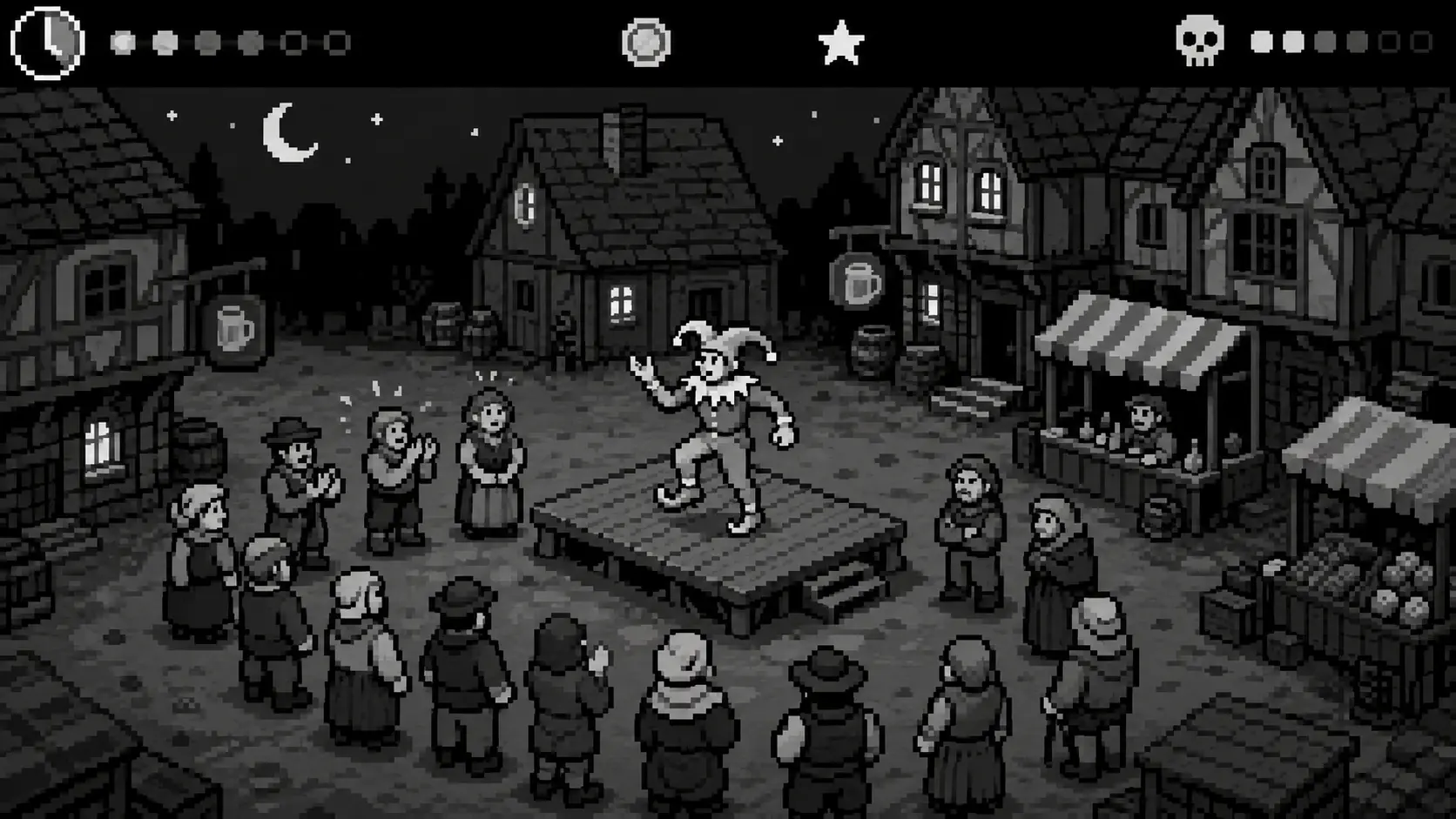
Each day is divided into three fixed phases.
Day – Preparation
During the day, the player uses a limited number of time slots to prepare.
Activities include:
- training skills
- writing new works
- training actors
- improving the den
- planning performances
Each action consumes one or more slots. Once they are used up, the day ends automatically.
Evening – Gathering
The evening is devoted to interacting with the game world.
The player can:
- spend time in taverns
- walk the streets
- visit workshops
- gather rumours and information
- gain temporary bonuses
This phase allows the player to read the social and political context before performing.
Night – Performance
Night is the moment of exposure.
The player chooses:
- whether or not to perform
- the type of performance
- the target audience
The performance produces:
- immediate reactions
- changes in fame and money
- physical or political consequences
SKILL SYSTEM
Skills represent the jester’s expressive abilities. They grow through use, practice, and certain narrative choices.
Skills do not operate in isolation: every performance results from their combination, together with actors, scenery, costumes, and theme.
The system rewards coherence rather than blind specialisation.
Core skills
Comedy Determines the ability to entertain, improvise, and read the audience. It includes jokes, comic timing, and imitations of characters or social types. It reduces immediate risk, but when used without substance it makes the performance superficial.
Voice Represents the jester’s vocal control. It affects impersonation, singing, declamation, and emotional modulation. A trained voice increases the impact of a performance even without elaborate staging.
Music Governs the ability to play instruments and accompany performances. Different instruments produce different effects depending on the type of show. Music improves emotional reception and approval, especially among common and merchantsle audiences.
Theatre Affects performance structure and narrative cohesion. It enables scripted works, ensemble scenes, and complex roles, increasing the symbolic depth of the show.
Acrobatics Introduces direct physical risk. It always remains dangerous: as the skill improves, the chance of failure decreases, but the risk never disappears. A mistake can cause permanent injury, performance limitations, or immediate death.
Writing Affects texts and songs, but does not work alone. Final quality depends on the coherence between writing, theme, and staging. Good writing can make a satire convincing, support a drama, or turn a song into a narrative vehicle.
PERFORMANCE TYPES
Every performance emerges from a combination of:
- available skills
- actors involved
- scenery and costumes
- chosen theme
Coherence is central. A theme handled with unsuitable skills leads to failure.
Performance themes and forms
Farce Light satire and caricatures of everyday life. Low risk, high immediate approval.
Tragicomedy An alternation of irony and pain. Requires balance and several combined skills.
Grotesque Exaggeration and distortion of roles. High risk, strong political impact.
Morality play Allegories and exemplary tales. Better suited to aristocratic settings.
Political satire Indirect criticism and masked characters. Extremely dangerous without sufficient prestige.
Narrative song Ballads and sung stories. Heavily dependent on music and writing.
PROGRESSION, FAME, AND PRESTIGE
Progression is automatic and tied to fame.
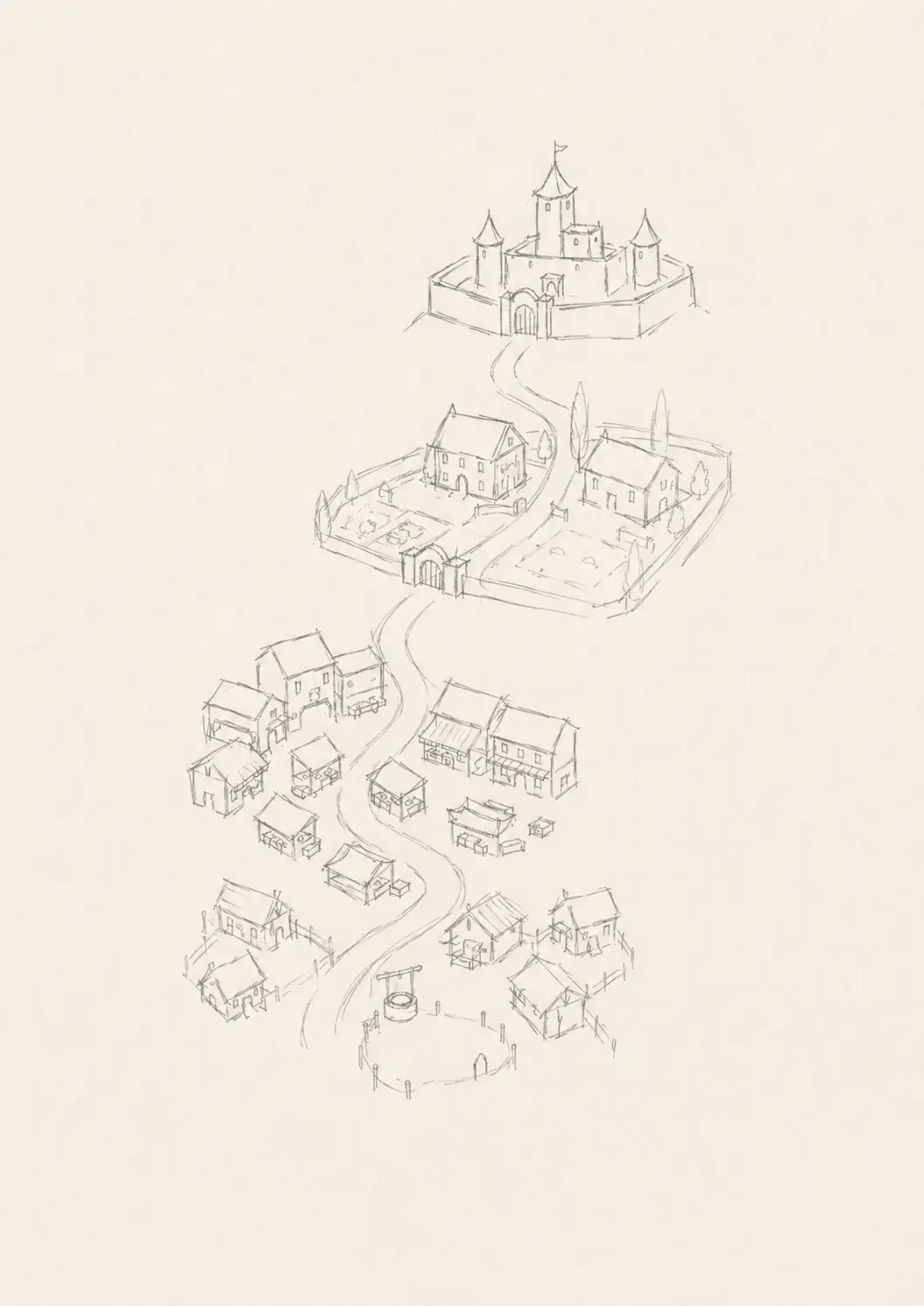
As fame grows, new settings are unlocked:
- commoners
- merchants
- nobles
- royal court
The jester can always return to perform in lower circles. This guarantees income and safety, but costs prestige.
There are narrative exceptions:
- commissioned performances
- political interventions
- propaganda missions
- public defence of a noble or the king
In these cases, performing “below” can become a strategic choice.
Prestige measures the jester’s symbolic position within the power system.
NARRATIVE SYSTEM
The simulation is threaded through with:
- a main storyline
- side missions
- persistent relationships
Missions are narrative situations, not checklists:
- ridiculing a figure of authority
- exposing oneself without the necessary skills
- choosing to remain silent
- telling the truth at the wrong moment
Every choice alters the context of the game world.
Among the main narrative threads, a love storyruns throughout the experience and leads to the final choice.
RISK, BODY, AND DEATH
The jester’s body is an integral part of the system.
Reckless or incoherent actions can cause:
- permanent injuries
- performance limitations
- immediate death
Death is permanent. The player can reload or begin again.
Risk is not always predictable. Saying the right thing at the wrong moment can be fatal.
NARRATIVE STRUCTURE AND ENDING
The game has an ending.
Over time, the jester builds relationships. Only one truly unsettles the balance: a relationship born away from the stage.
She watches his success grow. The fame, the money, the influence. And the danger too.
At the end, the choice is not imposed by power, but by a direct request.
She asks him to stop. To leave behind a life suspended upon other people’s judgement. To go away together, before words become a sentence.
The player must decide.
Renunciation The jester accepts. He grows old far from the court. He tells stories to his grandchildren. Words remain, but their function changes: they are no longer a risk, but something passed on. In a final scene he attempts an acrobatic trick. He falls clumsily. His grandchildren laugh—not at him, but with him.
Persistence The jester refuses. He says he cannot stop now. That his voice finally carries weight. That art comes before everything else.
He continues to perform. His fame grows; so does his isolation. He understands before the others that war is coming. The truth has been spoken, but no one has been saved.
WHY THIS GAME
Jester’s Dilemma begins with a question: how far are we willing to please others in order to keep existing?
It is a condition I have lived and experienced: wondering how far I was willing to go so that others would give me their approval and tell me, “Yes, Yasmine, you are good enough.”
I chose the figure of the jester because he embodies a freedom that is only apparent. He is often imagined as free to mock power and speak the truth without suffering the consequences. In reality, it was not quite so. His freedom was conditional. Truth could be tolerated through laughter. When it became too much, the jester could also be banished from court.
This contradiction is contained in the marotte. For anyone unfamiliar with it, the marotte is the jester’s mock sceptre: a staff often topped with a grotesque version of his own face. It could become a kind of puppet, an interlocutor, an alter ego—a second mouth entrusted with the truth, so that it was not spoken directly by the jester.
In the pairing of jester and marotte, I see an early figure of the artist and the storyteller: someone who observes, understands, and gives back what they have seen, but never simply. The jester does not set reality out: he stages it. He may do so through an acrobatic feat, a song, an imitation, or a story—but not a story reduced to a chronology of events or a list of facts. The jester transforms what he has seen into a form that can be heard. To me, that makes him one of the earliest images of the writer.
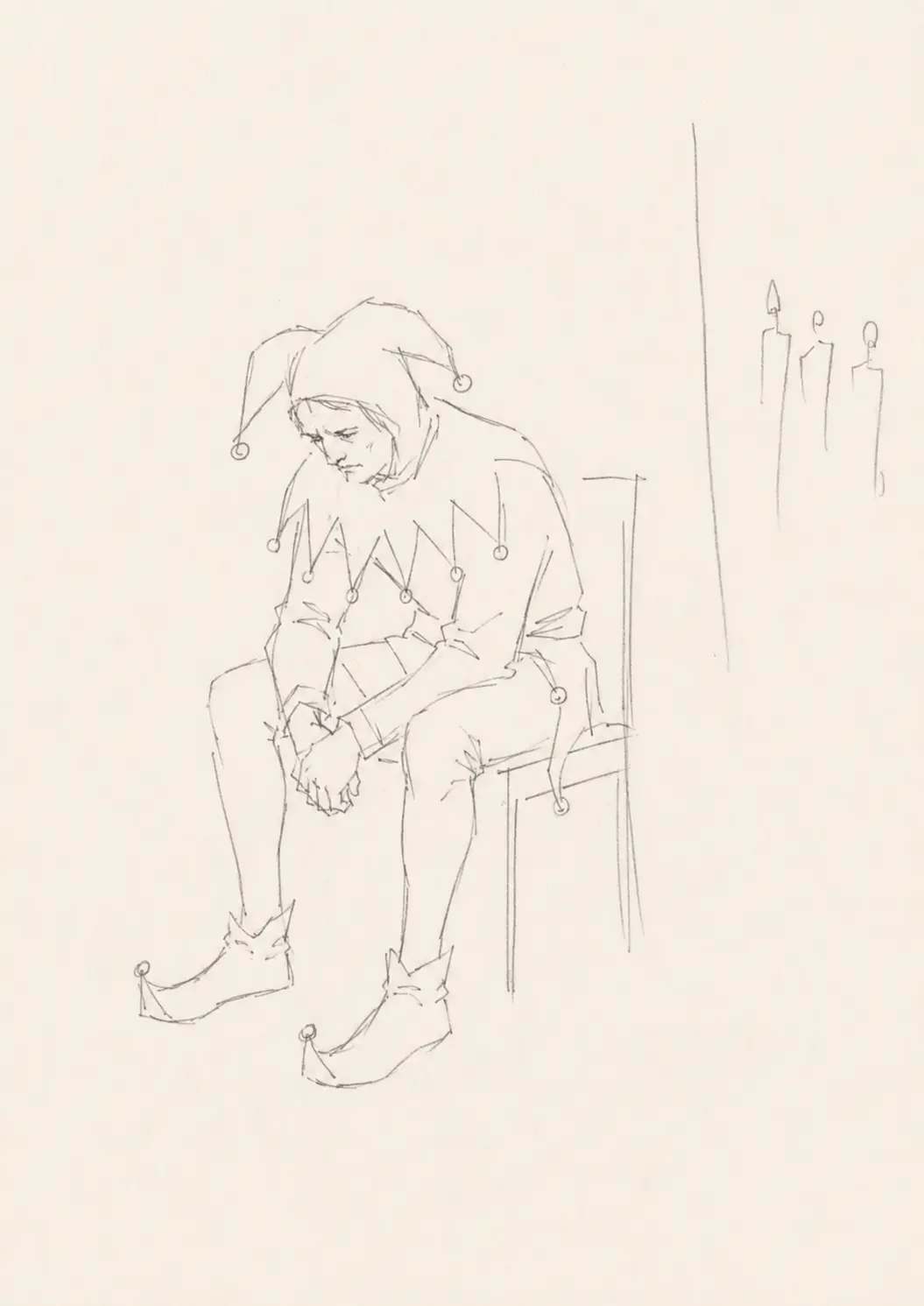
This idea is also connected to the explicit homage to Stańczyk by Jan Matejko. While the court continues to celebrate, the jester remains alone, aware of the magnitude of what is happening and of what the others refuse to see. He has spent his life laughing, singing, and turning reality into performance, yet he is the one who understands its tragedy.
In Jester’s Dilemma, I tried to bring all these elements together. The player must entertain the audience to survive, but this extreme condition also represents something that happens in everyday life: the attempt to balance who we are, what we want to say, and what we must show in order to be accepted and appreciated.
Then there is the weight of words. When a voice gains importance, it can change habits and people, create possibilities, or cause trauma. Every success gives the jester more room for expression, but also makes him more dependent on the audience and the power that allowed him to claim it.
This is the dilemma: the desire to say something that matters, something that might help and that one feels compelled to say, while knowing that, to do so, one must first survive. One must manage to exist within oneself without becoming entirely what others are willing to approve.