Morbosus
A narrative survival horror built around experiential design, psychological gameplay, and awareness systems.
ETYMOLOGY
MORBOSUS
From the Latin morbosus, related to morbus: illness, disease. The term denotes what belongs to a pathological condition and, figuratively, what becomes excessive, unmeasured, obsessive.
The title evokes the core of the game: the increasingly unstable boundary between illness, perception, obsession, and reality.
INTRODUCTORY NOTE
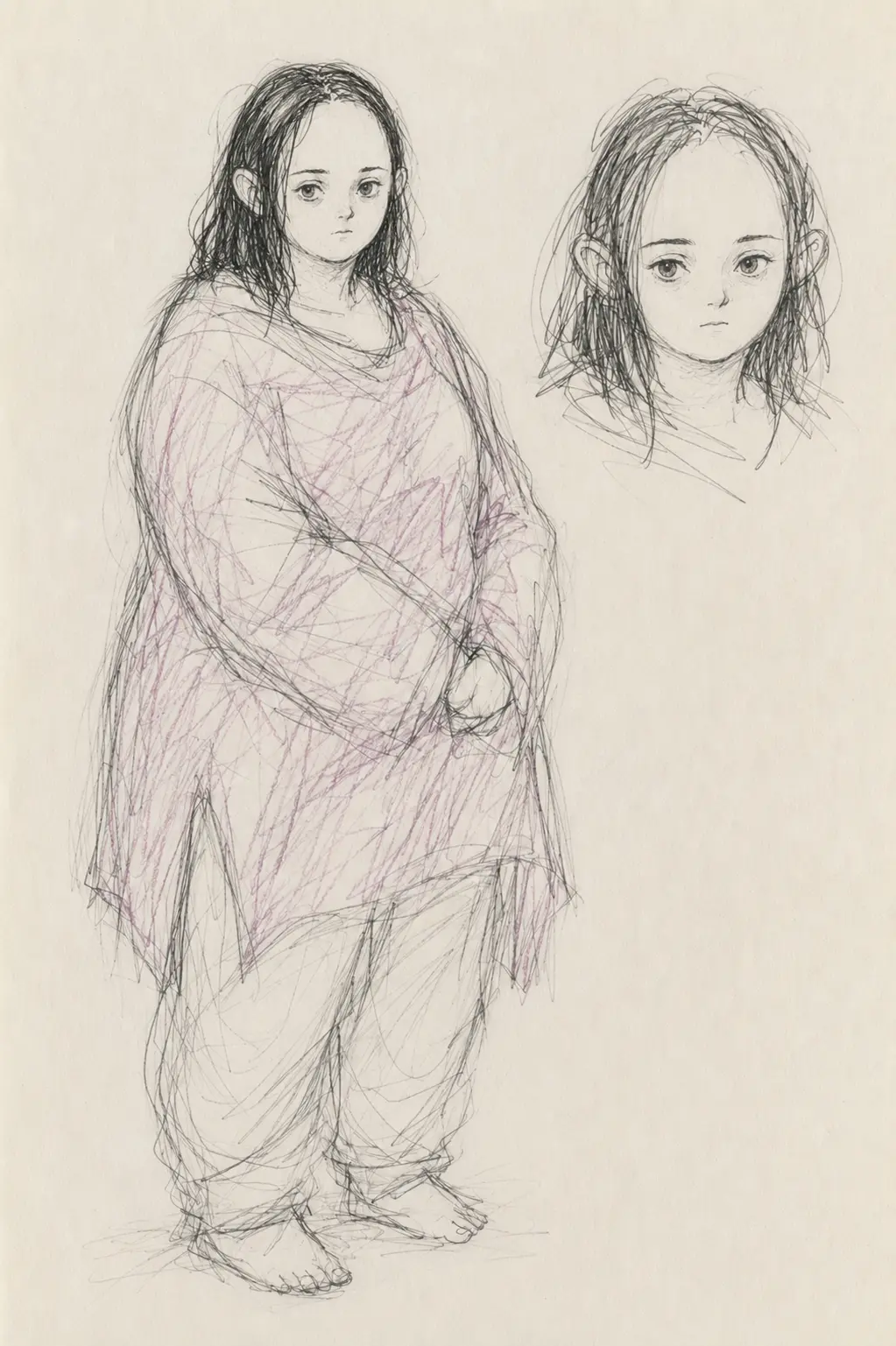
Morbosus is a narrative and game design project. Its characters, bodies, and situations serve symbolic and systemic functions within the gameplay experience.
Morna’s body is not intended to describe, diagnose, or judge real conditions.
In Morbosus, weight is used as a narrative and mechanical language to represent burden, responsibility, and the redistribution of trauma.
The game offers neither clinical solutions nor therapeutic models, and does not distinguish between “right” and “wrong” experiences.
narrative survival horror
GAME OVERVIEW
Morbosus is a narrative survival horror in the third person, set inside an experimental process for reworking trauma. The player controls Morna, a woman trapped in a house that gradually changes in response to her growing awareness.
The game is not about escape or recovery. Its core is the management of weight: what Morna chooses to face, what she ignores, and the cost of every form of knowledge.
Exploration is slow and claustrophobic, guided by objectives rather than linear missions. Clues, documents, environmental puzzles, and fragments of memory allow the player to reconstruct past events, but every truth uncovered makes the environment more unstable and hostile.
In Morbosus, knowledge does not make you stronger. Awareness shortens the margin of mental lucidity, accelerates its collapse, and empowers hostile presences. The player must choose how deeply to investigate, when to stop, and which version of reality they are willing to sustain.
Combat is present, but not dominant. Physical threats are concrete and can be permanently eliminated with weapons, freeing the space. Mental presences begin to appear as Morna’s Lucidity decreases: they cannot be fought or destroyed. The player can only flee, hide, or avoid them.
The game ends with a revelation that reframes the experience: what seemed to be a prison may be read as a process, and what appears to be liberation may prove to be another form of surrender.
The ending does not distinguish between good and evil, but between weight that consumes and transferred weight.
PRACTICAL GAMEPLAY EXPERIENCE
In Morbosus, the player experiences the game through a combination of exploration, puzzle-solving, resource management, and targeted encounters. The pace is deliberately slow and oppressive, designed to make the weight of decisions felt more strongly than the efficiency of action.
Game loop
The main loop unfolds through four recurring phases:
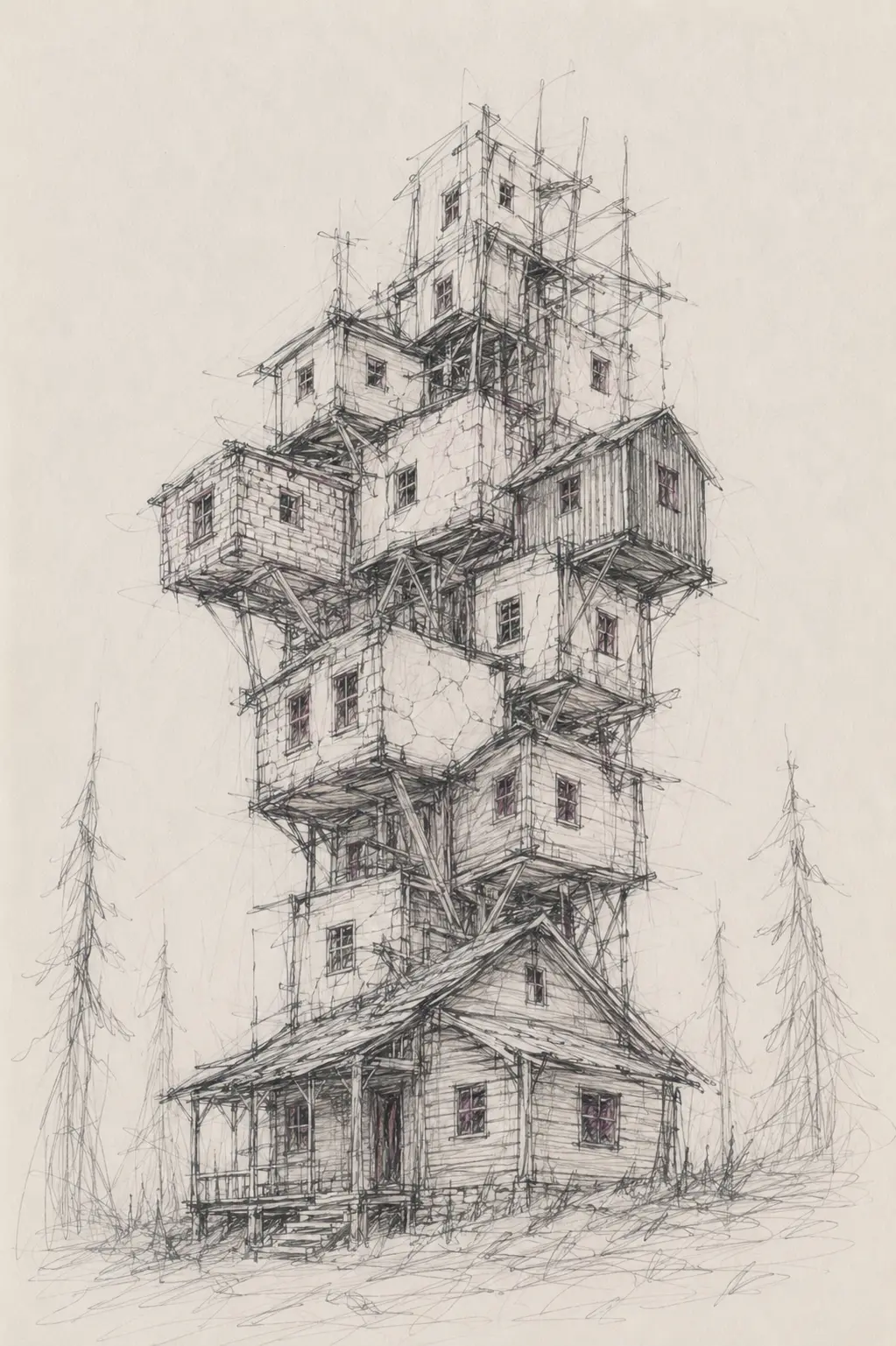
- Exploration — The player explores the rooms of the house, observing changes, identifying anomalies, and collecting clues. Each area is designed to suggest information without explicit guidance, pushing the player to interpret what they find.
- Reconstruction — Documents, photographs, recordings, and objects allow past events to be reconstructed. These elements are never purely informative: every discovery increases awareness and alters the behaviour of the environment.
- Interaction and puzzles — Environmental puzzles are tied to spatial arrangement and found objects. They demand observation and deduction rather than abstract skill. Solving them enables progress or unlocks new paths, but always carries a cost in mental stability.
- Confrontation — The player may face threats of different kinds. Physical presences can be confronted and, once destroyed, permanently clear the space. Mental presences emerge as Lucidity is lost and cannot be confronted: Morna can only flee, hide, or avoid them.
Resource management
Morbosus uses two main resources:
- Health, representing Morna’s physical integrity.
- Lucidity, representing her margin of mental clarity.
Lucidity can not only decrease; it also shrinks as awareness grows, progressively reducing the player’s margin for error. Total loss of Lucidity leads to mental collapse and madness.
Choices and consequences
The game does not stop the player for explicit decisions. Choices emerge through behaviour:
- how far to explore
- which puzzles to face
- when to fight
- when to avoid
Every decision shifts the balance between survival and knowledge, leading to one of two possible endings.
Core mechanics
Morbosus builds its experience through a set of interdependent mechanics designed to bring out the conflict between survival and knowledge. Every system is meant to constrain, not empower.
Lucidity and awareness
The Lucidity represents Morna’s margin of mental clarity. It is not a static resource: it is consumed, shrinks, and grows increasingly fragile.
The awareness increases when the player discovers information, solves optional puzzles, or reconstructs past events. Every increase in awareness reduces the maximum length of the Lucidity bar, accelerating its collapse.
In Morbosus:
- knowing more makes the world more hostile
- it reduces the margin for error
- it increases the risk of madness
Total loss of Lucidity leads to mental collapse and failure.
Combat
Combat is present, concrete, and based on resource management.
Firearms allow the player to permanently eliminate physical enemies, offering immediate relief and allowing control of the space to be regained, in keeping with a classic survival-horror approach.
Limited ammunition and slow reload times make every encounter a considered choice, but an enemy’s elimination is real and permanent.
As awareness rises, the game introduces tougher and more dangerous presences, making combat progressively more demanding without negating its effectiveness.
The weapon is a tool of concrete, not symbolic, survival. It enables progress, but does not stop the world from becoming more hostile.
Mental presences
Some entities cannot be physically harmed. They begin to appear as Morna’s Lucidity falls.
They cannot be fought or eliminated. Morna can only:
- flee
- hide
- avoid them
Recovering Lucidity is a necessary system mechanic that has yet to be defined.
Enemy progression
The world’s hostility grows in relation to the player’s awareness.
As awareness increases:
- enemies become more numerous or aggressive
- new types of presence appear
- environments become less stable and more dangerous
Difficulty does not increase over time, but in response to the player’s choices.
Environmental puzzles
Puzzles are integrated into the environment and tied to reconstructing events. They require not abstract skill, but observation, deduction, and interpretation of found materials.
Solving a puzzle can:
- unlock new paths
- provide key items
- increase awareness
Solving a puzzle is itself a choice: advance without understanding, or understand at the cost of exposure.
Failure
Morbosus includes two forms of failure:
- loss of Health
- collapse of mental Lucidity
Both end the experience, but neither is framed as moral punishment. They are direct consequences of decisions made during play.
ENEMIES AND TYPES OF PRESENCE
In Morbosus, hostile presences are organised not by levels or traditional escalating difficulty, but by function. Each enemy type requires a different approach and places different resources under pressure.
Rising awareness does not simply make enemies stronger, but more structured, progressively reducing the player’s options.
Physical presences
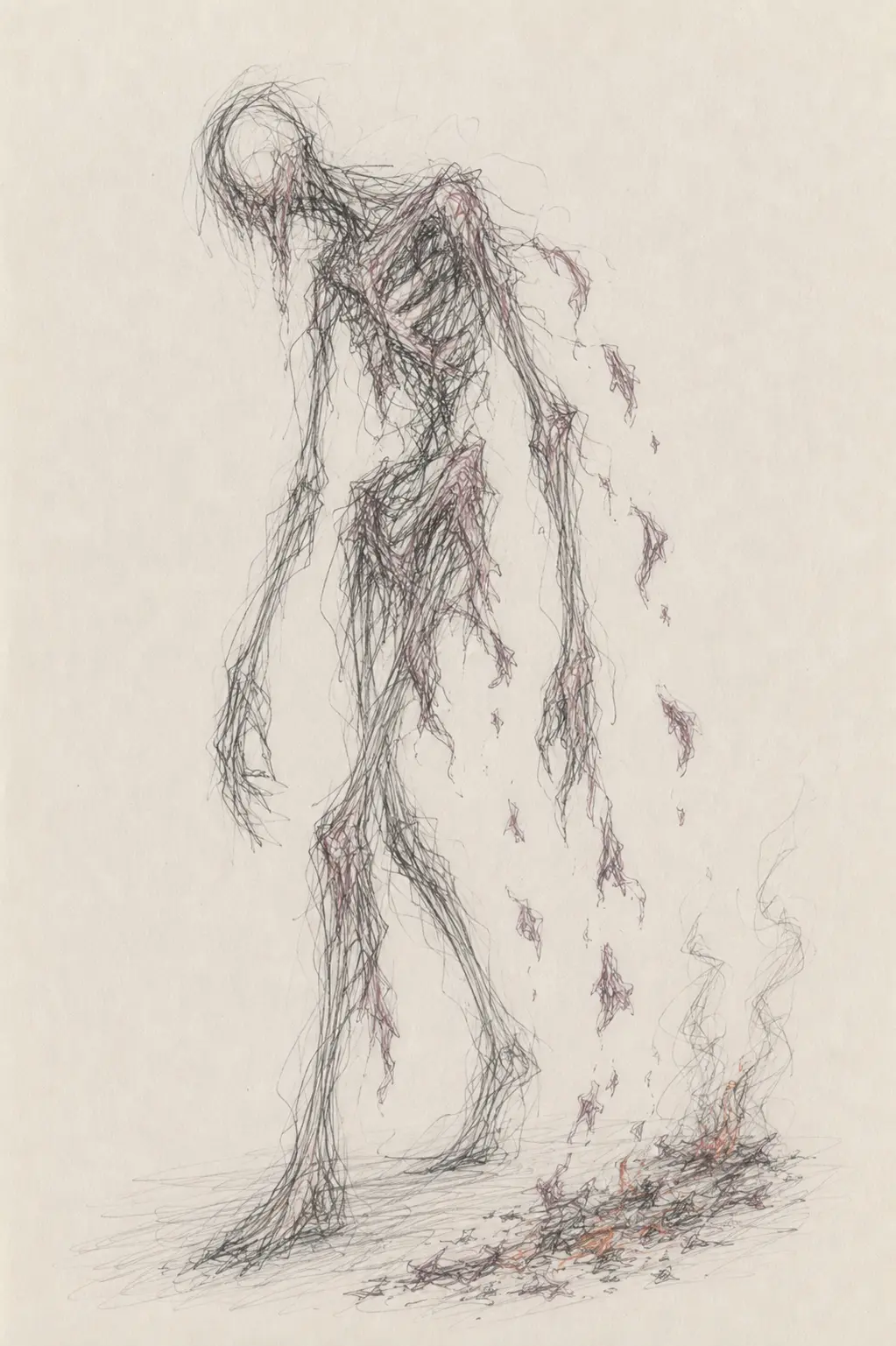
Physical presences are entities with body and mass, perceptible in space and confrontable through direct combat.
Visually, they appear as unstable shadows threaded with fragments of flesh, deteriorating as they move and leaving fleeting traces behind them.
Core characteristics:
- they can be permanently eliminated with weapons
- they occupy space and obstruct exploration
- they inflict direct damage to Morna’s Health
As awareness increases:
- they become more resilient
- they appear in greater numbers
- they introduce more aggressive attack patterns
Eliminating a physical presence offers real relief, but does not reduce the world’s overall hostility.
Mental presences
Mental presences have no stable body and cannot be physically harmed. Their appearance is tied to the decline of Morna’s Lucidity.
When they emerge, the player has no offensive solution: they must flee, hide, or avoid them. The system therefore requires a way to recover Lucidity, a mechanic yet to be defined.
Bosses
Bosseses represent extreme concentrations of weight, tied to key moments in the process.
They are not merely empowered enemies, but structured encounters combining:
- direct combat
- resource management
- resolution of specific mechanics
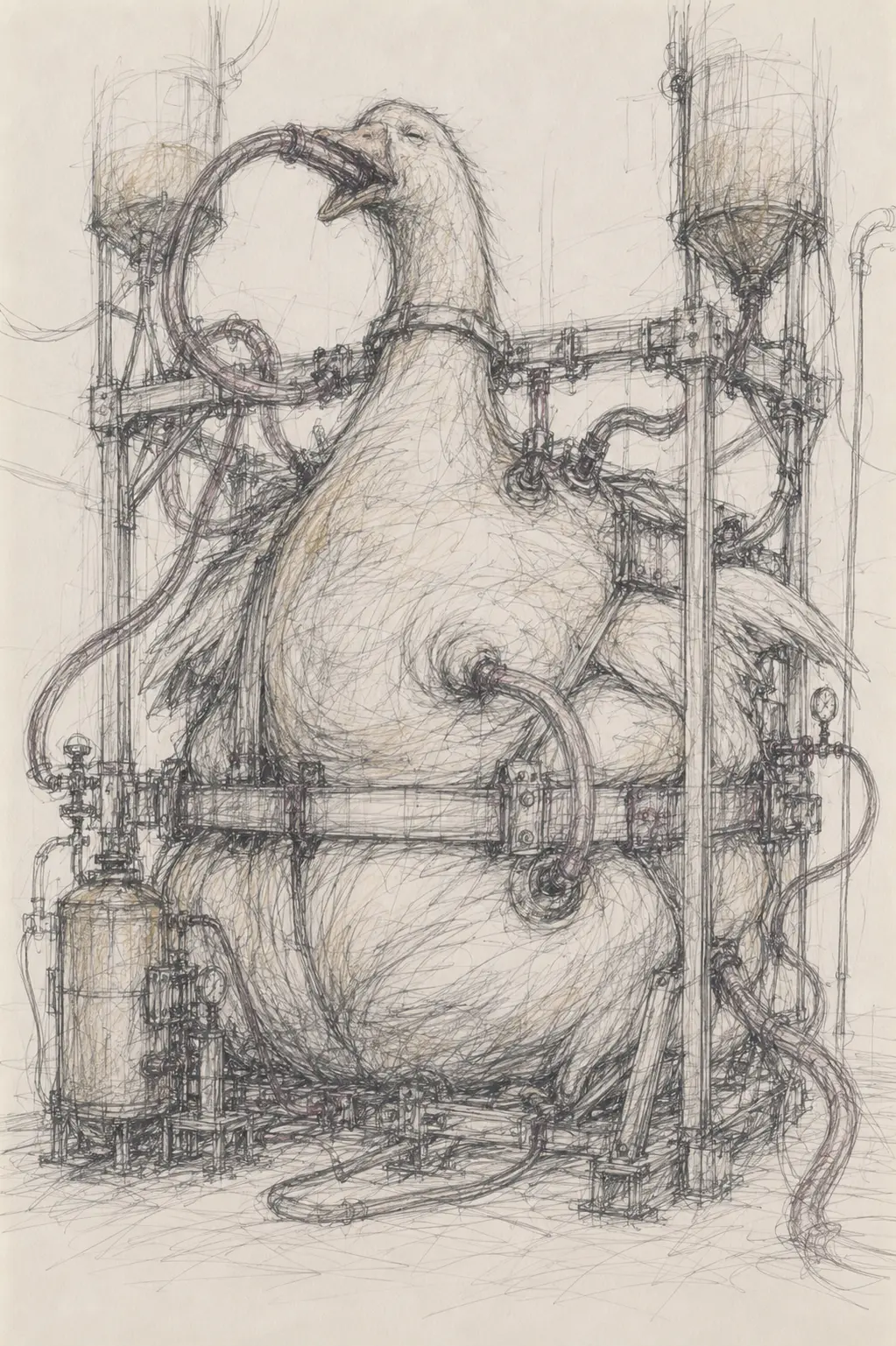
Bosses: a creature kept alive and fed as part of a system.
The encounter is not about striking the creature, but interrupting its feeding
One example is the boss Foie Gras, a creature force-fed through a mechanical system. The encounter cannot be resolved through force alone: combat is used
to create windows of opportunity in which to interrupt the feeding and destabilise the entity.
Bosseses are defeated not through total elimination, but through the collapse of the system sustaining them.
Relationship with awareness
Enemy presence and danger are directly tied to the player’s level of awareness.
The more Morna discovers:
- the more defined the presences become
- the more resources encounters require
- the less room remains for error
The game does not punish exploration; it makes its cost visible.
NARRATIVE DESIGN AND STORY STRUCTURE
The narrative of Morbosus is built as a progressive system of revelation.
The story is neither linear nor explanatory; it emerges through action, exploration, and the consequences of the player’s choices.
The player does not witness events: they pass through them.
The narrative structure aligns story progression with increasing risk, turning every acquired piece of information into a potentially harmful choice.
Spoiler-free narrative
At the beginning, Morna finds herself inside an apparently real house inhabited by ambiguous family presences and incomplete memories. The initial context suggests a conventional reading: bereavement, an unresolved past, an unstable mind.
The player reconstructs events through:
- written documents
- photographs and footage
- personal objects
- puzzle ambientali
Information is never presented chronologically or neutrally.
Every discovery alters the environment’s behaviour, increasing mental pressure and the danger posed by hostile presences.
The game does not push the player towards an immediate truth. It gradually exposes them to contradictions, forcing them to revise their interpretation of events.
⚠️SPOILER– COMPLETE NARRATIVE STRUCTURE
Story layers
The story of Morbosus unfolds across three overlapping layers.
1. Perceived story
This is the initial layer of the experience. Morna lives inside a house that seems to reflect a distorted family past: her father is present, her mother absent. This arrangement is not accidental, but represents the most “stable” point of entry into the process.
The player is led to identify the father as the first narrative knot and the house as a projection of the past.
2. Reconstructed story
As exploration continues, the player identifies discrepancies between what is shown and what emerges from the collected material.
The father’s role progressively recedes, while the mother emerges as central and destabilising. Maternal violence is not suggested symbolically, but reconstructed through facts, testimony, and dynamics of control.
This layer introduces no interpretive ambiguity: once the truth emerges, it is clear and undeniable.
3. Actual story
In the ending, the player understands the true nature of the experience.
The house is neither a memory nor an unconscious projection. It is a functional structure, designed to lead the subject through narrative knots in order of resistance.
⚠️SPOILER– THE PROCESS
The process
The entire experience of Morbosus takes place inside an induced process, which Morna voluntarily underwent before the game began.
The process is not therapy and has no curative purpose. It is an experimental procedure designed to extract, concentrate, and transfer a person’s emotional and traumatic weight.
Morna enters the process with no memory of the procedure itself. The environment is standardised and identical for every treated subject. What varies is not the place, but the form the subject takes within it and the way they react as truth progressively emerges.
The process does not judge. It exposes.
⚠️SPOILER– THE CULT
The cult
The organisation behind the process does not operate like a traditional cult. It does not isolate, coerce, or create closed communities.
Its goal is to build a utopia without pain or trauma, founded on a radical principle: emotional weight cannot be eliminated, only transferred.
The weight extracted from subjects is accumulated and deposited in land acquired by the organisation. This space acts as the final container for the collective emotional burden, but progressively deteriorates as if absorbing a toxic substance.
The system works only by moving the problem elsewhere.
⚠️SPOILER– ENDINGS
Narrative outcomes
The game leads to two main endings.
In both cases, the weight does not disappear.
The ending does not distinguish between good and evil, but between:
- weight that crushes
- weight that is moved elsewhere
In the first, Morna cannot free herself of the burden and is excluded from the utopian project, driven towards self-destruction.
In the second, Morna frees herself by transferring the weight elsewhere and returns to the real world, leaving behind a residue destined to contaminate something else.
Neither ending resolves the problem.
Both reveal the systemic cost of a future without pain.
Why this structure
The narrative of Morbosus does not seek to surprise through a twist, but to retroactively reposition the player’s experience.
The game does not ask the player to decide what is right. It shows what happens when pain is treated as a resource to be redistributed.
WHY THIS GAME
Morbosus begins with a rejection of two recurring simplifications in narratives of trauma: its aestheticisation and its resolution.
Many works use trauma as an emotional backdrop or a path to healing. Morbosus instead treats it as a quantity, a weight that does not disappear and can only be moved, concentrated, or redistributed.
The game offers no genuine liberation. It shows systems that function only because someone else pays the cost.
The horror of Morbosus does not come from fear of the unknown, but from the progressive clarity of the dynamics at work. The player is not pushed to interpret, but to recognise.
Morbosus exists to explore a specific question: what happens when pain is treated as a resource to be managed, rather than an experience to be lived through?
It offers no comfort, redemption, or catharsis. It offers consequences.
The game is designed to be played to the end, but not to grant the player emotional closure.
The experience ends, but the system that made it possible remains intact.