Bombs Are Handmade Objects
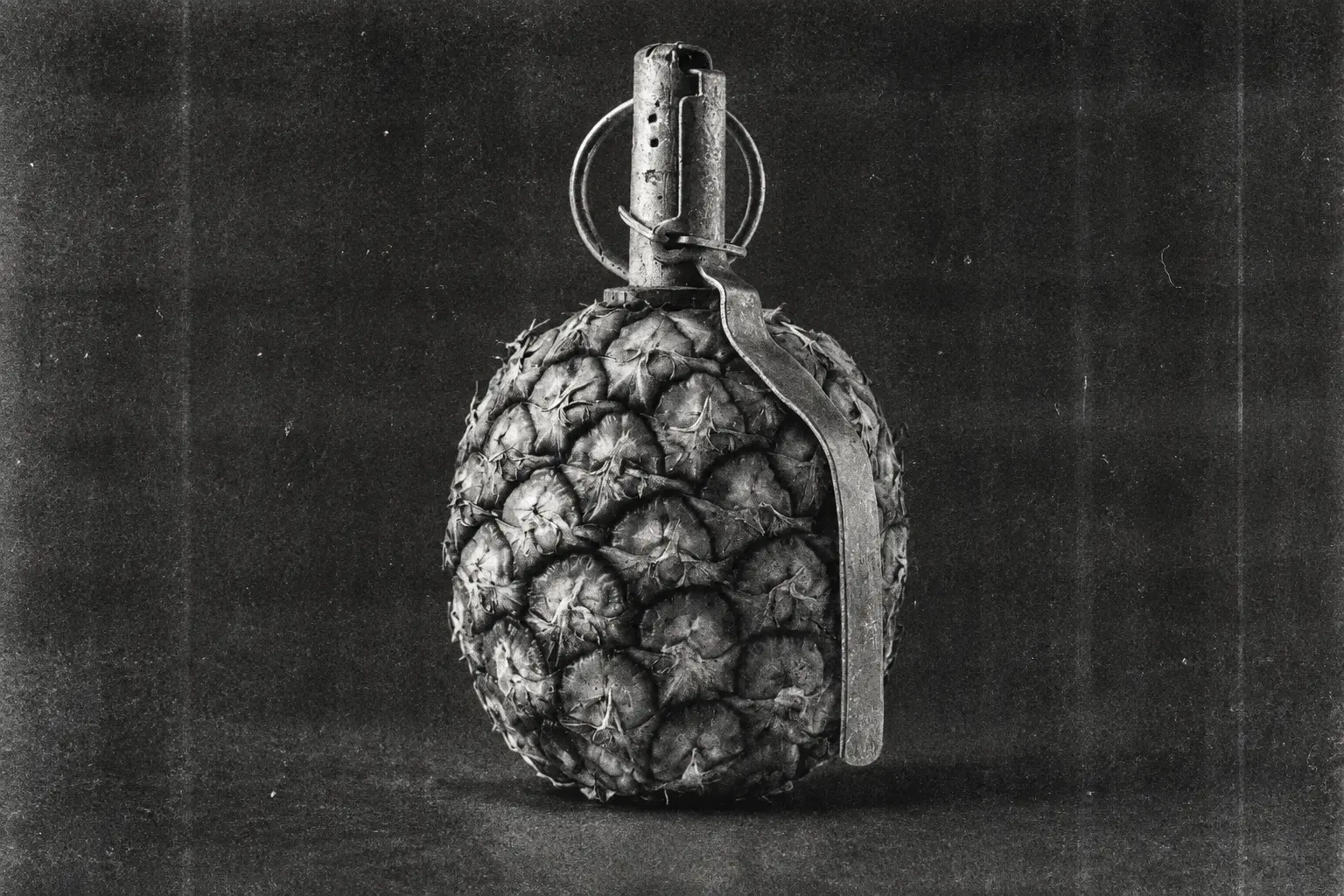
We must not lose our humanity.
That is the trend for 2026.
When we read or hear people speak of humanity, the meaning is almost always implicit.
Humanity becomes synonymous with the good human: empathy, listening, care, kindness, sensitivity, attention, creativity.
It is a word that points to the best part of the human being.
The problem is that this is not the only possible meaning, and historically it is not even the original one.
Everything else is pushed to the margins, as though cruelty, domination, violence, selfishness, sadism, or destruction were anomalies.
And yet they belong to the human, and let us admit it: they are among the forces that generate the most interesting creativity—the kind that investigates deviation.
That is why it is worth taking a small step back.
A brief historical *excursus*.
I will keep it short, I promise.
To understand why we use humanity in its most Disneyfied sense.
1. Etymology
Humanity derives from the Latin humanitas.
Humanitas derives from humanus, meaning human, proper to human beings, as opposed to what is divine or animal.
Humanus in turn derives from homo: man in the sense of human being, not in the moral sense.
At its origin, therefore, humanitas it does not mean goodness.
It means the human condition.
In Classical Latin humanitas it chiefly indicated the formation of the human being: education, culture, and the development of the intellect.
Only in certain contexts could it also mean affability or benevolence, but as a character trait, not as its central meaning.
2. The Roman shift: Cicero
In the first century BCE, Cicero uses humanitas systematically.
For him, the word chiefly denotes the ideal of a person shaped through education, culture, and the liberal arts.
Humanitas thus becomes an ideal of civilisation and education.
It means being a human who is educated and cultivated.
This is the first moment in which the word begins to filter the human through a cultural ideal.
3. The Middle Ages
In the Christian Middle Ages, the term undergoes another shift.
Humanitas is increasingly associated with:
• compassion
• charity
• mercy.
Humanity thus becomes a moral virtue.
The capacity to feel compassion and concern for other human beings.
4. The Renaissance
The Renaissance gives rise tohumanism.
The term once again denotes human cultural formation: the study of letters, the arts, and philosophy.
This is the origin of the word humanist.
But the human is progressively associated with:
• dignity
• rationality
• moral worth.
5. The Enlightenment
In the eighteenth century, the meaning changes again.
With the Enlightenment and thinkers such as Rousseau and Kant, humanity becomes a universal moral category.
It becomes linked to ideas such as:
• human dignity
• human rights
• moral sensitivity.
This is where the modern meaning truly emerges.
6. The contemporary age
In contemporary language, the term settles into place.
When we say it today humanity, we almost always mean:
• empathy
• solidarity
• sensitivity
• care.
Human virtues. Not the whole human.
Now, we might say it is only a word.
But we need only look at how central it has been throughout the eras we have crossed.
Let me quell any possible revolt at once: I am not anti-human.
I am simply trying to account for the whole.
When I write, I try—as far as I can—to look at the human in its entirety.
The emotions, the contradictions, the deviations.
We speak of talent, craftsmanship, essence, and I can answer that bombs, too, are handmade—and damned human..
That is what I fear: when a word becomes moral, it stops describing and begins prescribing.
At that point it is no longer portraying the human. It is saying what the human ought to be.
And here words become more than mere tools: they become narrative.
Our brain lives on narratives.
This is how we organise the world, give meaning to things, and decide what counts as our “right” and “wrong”.
That is why words carry an enormous responsibility.
When we narrow them too far, when we turn them into absolute ideals, we risk ceasing to see the human for what it is: complex, contradictory, capable of wonders, but also of destruction.
And perhaps this is also why the word humanity now returns so often in conversations about technology.
AI is becoming a very convenient scapegoat.
Much of the discourse sounds roughly like this: beware, AI will make us lose our humanity.
But human beings handed themselves over, long before AI, to logics of efficiency, standardisation, performance, and productivity.
AI did not invent the assembly line, nor the metrics that turn every activity into measurable performance. The culture of blood and toil predates artificial intelligence by a long way.
And so the word humanity becomes consoling: a warm, reassuring word that says very little. In smarketing it is saturated, like innovation. You use it, insert it, invoke it, sing its praises—without knowing exactly why, what you are referring to, or what you are talking about.
Conclusion?
Perhaps the point is not to defend humanity as an ideal.
Perhaps the point is to keep exploring it.